
Why Choose Saturday Over Claude Code, OpenCode, Goose, and Hermes
Cheap $/MTok still wastes money if an agent loops 40 times or re-sends 15k tokens of bloated context every step. Here is how Saturday wins on cost per solved task — and where it diverges from coding-only harnesses.
- 1Price per million tokens is not the bill.
- 2Every turn re-sends the history, so a long context is paid for repeatedly.
- 3Judge an agent by cost per finished job.
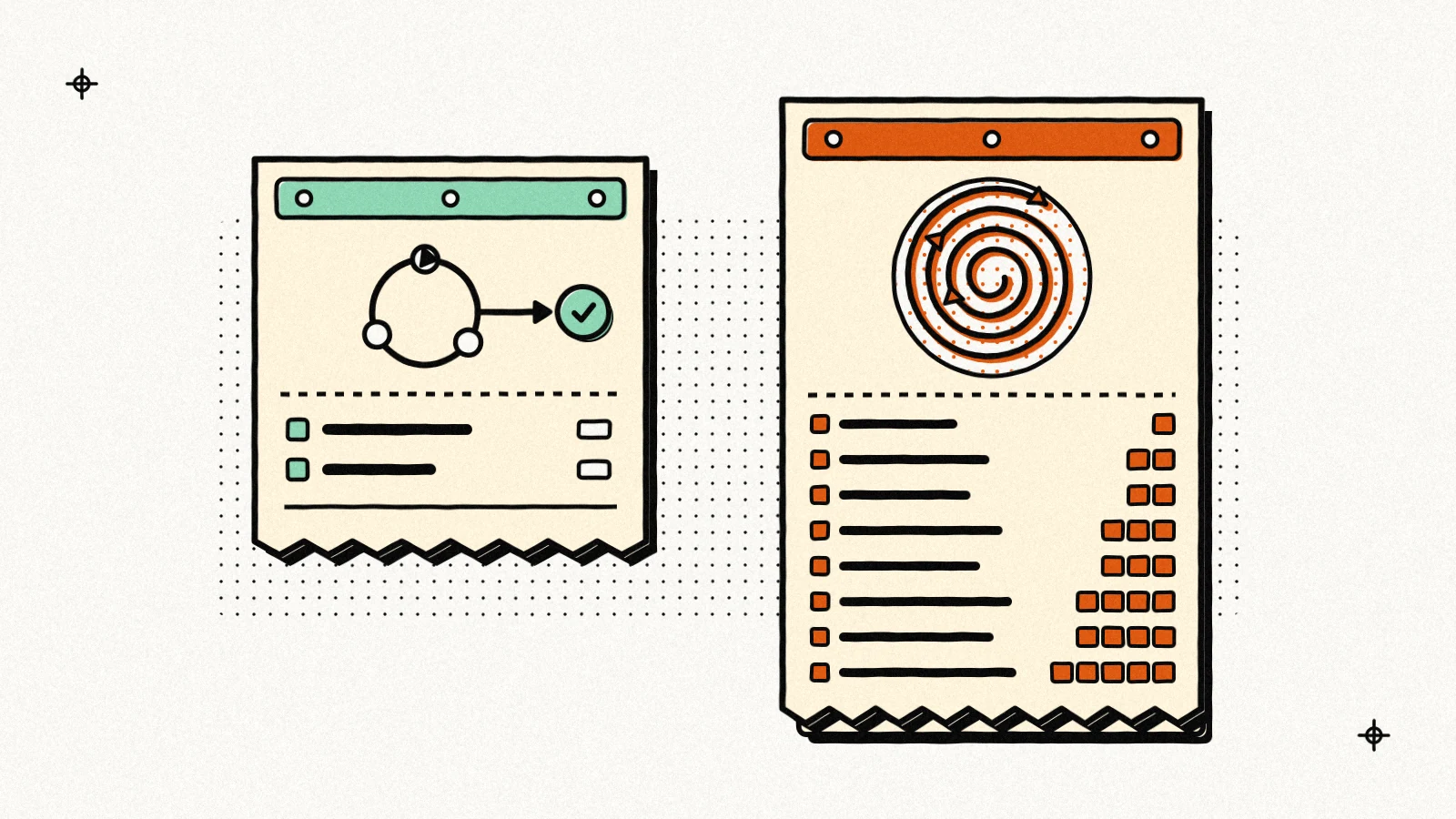
Most agent harnesses compete on sticker price, or on dollars per million tokens. That misses the real bill. On a multi-step job, every message and every tool output in the history is re-sent on every later turn. A single 1 MB build log is paid for twenty-five times. So is a set of 72 verbose tool schemas. That repeated charge swamps any per-million-token discount.
Follow one job through this post: a 25-turn coding task whose fifth turn produces a 1 MB build log. Nothing about the log changes after turn five, and its cost does not stop either. The next four sections are what Saturday does about that.
1. Win on cost per solved task, not just $/MTok
Saturday (v0.16.10) cuts token spend inside the harness before the provider invoice is calculated. Every optimization below is measured in the repository:
| Optimization | How it works | Measured impact |
|---|---|---|
| Tool-output spilling | Writes payloads over 24,000 chars to disk once; sends a bounded head+tail preview the model can page or grep | 97.7% saving (200 KB), 98.3% (256 KB), 99.6% (1 MB) |
| Log compaction & history dedup | Collapses ANSI/CR/repeat noise and deduplicates superseded tool results across turns | 97.7% noisy log compaction; 75.1% history dedup + demotion |
| Auto small-model optimization (<=14B) | Auto-narrows tools (89->13), compacts system prompt, masks old observations, coerces schema args | -62.1% prompt tokens/step live on Ollama qwen3.5:4b (-76% prompt chars) |
| Dynamic tool schemas (default ON) | Loads long-tail schemas on demand via tool_schema instead of shipping all 72 schemas every turn | Keeps prompt prefix lean without dropping tools |
| HTTP keep-alive pool + gzip | Persistent per-host HTTP/HTTPS pool, TCP_NODELAY, shared SSLContext, transparent gzip decode | 25 turns: 25->1 TCP conn (2.00x faster), 92.6% gzip wire reduction |
| Multi-vendor prompt caching | Native Anthropic cache_control + TTL, OpenAI prompt_cache_key, OpenRouter breakpoints, Gemini cachedContent | Live cache-read tracking and discounted cost accounting |
2. Ride cheap inference without hitting 5-hour caps
Saturday ships 22 built-in provider profiles. They include OpenCode Console, with provider-scoped pricing for its discounted models, and DeepSeek direct, with 50% off-peak UTC pricing tracked automatically. They also include Cerebras, OpenRouter and Cloudflare Workers AI, plus three local runtimes: Ollama, vLLM and llama.cpp.
# Enable cascading, causal slicing, failover, and dynamic schemas in one line
saturday config --preset low-cost-cascade
The low-cost-cascade preset routes tactical edits to your cheapest or free tier. It escalates to a frontier model only on multi-file architecture work or repeated failure. If a subscription hits its 5-hour quota wall, Saturday backs off and spills over to your next configured provider. If none is left, it falls to a $0 local model rather than stranding the run.
3. Head-to-head: Saturday vs. Claude Code, OpenCode, Goose, and Hermes
| Capability | Saturday v0.16.10 | Claude Code | OpenCode | Goose | Hermes |
|---|---|---|---|---|---|
| Models & providers | 22 providers + 3 local + Claude/ChatGPT/Grok/Google/Copilot OAuth | Anthropic only | Multi-provider + Go caps | Multi-provider | Multi-provider / Nous |
| Runtime footprint | Zero runtime deps (pure Python stdlib core) | Node.js CLI | Go/TS binary + server | Rust/Node + extensions | Python + deps |
| Work beyond coding | 72 tools, 15 verticals, background computer use, 24/7 daemon, chat bots, mobile app | Coding CLI/IDE | Coding CLI/TUI/desktop | Dev + MCP recipes | Coding / research |
| Supervises other harnesses | Yes — 22 CLI agents under one safety floor & spend cap | No | No | No | No |
| Hardline safety floor | Non-overridable destructive/credential/git-push floor + credential READ gates + 4.5s STOP latch | Permission prompts (bypassable) | Basic permissions | Extension permissions | Hook-based |
| Audit & receipts | Hash-chained replayable logs + Ed25519 Signed Proof Bundles | Local transcripts | Local sessions | Session logs | Trajectory export |
4. Keep your existing coding agent — run it under Saturday
You do not have to throw away Claude Code, OpenCode, Codex, Cursor or Goose to adopt Saturday. Saturday can act as a supervising host over 22 external CLI harnesses. It bounds their process trees, routes cheapest-tier-first, enforces a single spend cap, and records every run in one audit trail.
Questions people ask
Is Saturday cheaper than Claude Code per token?
Per-token price is not the bill. Every turn re-sends the conversation and its tool output, so a cheaper rate on a long loop can cost more than a dearer rate on a short one. Saturday cuts what gets re-sent: oversized tool output becomes a preview backed by a file on disk, noisy output is compacted, and superseded history is deduplicated.
What does cost per solved task mean?
The total provider bill for a job that finishes, divided by the jobs that finish. It includes retries, re-sent context and failed runs, which a dollars-per-million-tokens table leaves out.
Do I have to replace Claude Code or another coding agent?
No. Saturday can supervise 22 external CLI harnesses, including Claude Code, OpenCode, Goose and Hermes, under one spend cap and one audit trail. It can also run its own loop with 72 built-in tools.
What happens when a provider quota runs out mid-job?
Saturday backs off and spills over to the next configured provider, or to a local model that costs nothing per token, instead of stranding the run.
Try Saturday on your own machine
Free during the beta · 72 built-in tools · 22 providers (19 cloud, 3 local) · no account needed.