
Did That Harness Change Actually Help? Measuring Gains Without Overfitting
Recent harness-evolution research found ~68% of claimed agent improvements were benchmark overfitting plus extra compute. Saturday ships an opt-in Improvement Ledger that runs that exact decomposition before any change is kept.
- 1Most reported agent gains do not survive a held-out test.
- 2One good run is not evidence: the ranges overlap.
- 3Saturday compares many runs before it keeps a change.
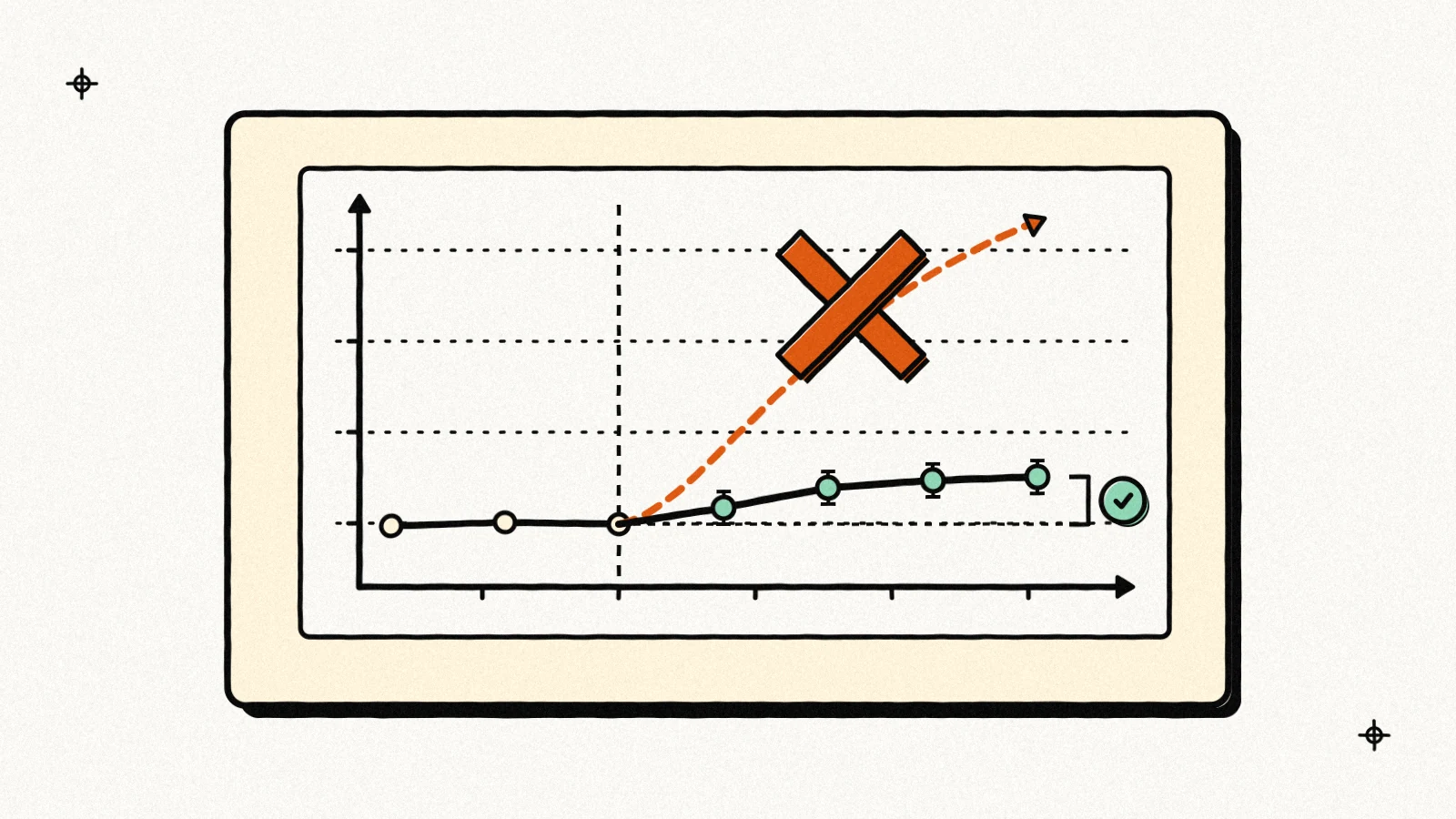
Everyone tweaks prompts, skills and tool descriptions, and almost everyone fools themselves when they measure the result. HDA (arXiv:2610.22466) dissected 21 harness-evolution settings. It found that roughly 68% of reported gains disappeared once evaluated on a held-out stream and matched for compute.
The case to keep in mind is a change that looks like a clear win: a skill edit that lifts invoice extraction by six points on the eval set. Six points is noise until it survives a held-out set and a baseline that spends the same tokens.
Four paired arms, three-way attribution
Saturday includes an opt-in Improvement Ledger (default OFF: improve_enabled=false) that evaluates skill edits, prompt templates, and harness files across paired arms:
| Arm | What it measures |
|---|---|
| Eval (candidate vs. baseline) | Headline pass-rate delta and bootstrap confidence interval |
| Held-out (disjoint command) | What actually transfers — separating real progress from overfitting |
| Compute-matched baseline | Repeats the baseline until it spends what the candidate spends — exposing gains bought purely by extra tokens |
Verdicts with teeth
- DEMOTE: an eval gain that collapses on held-out or compute-matching is automatically reverted to its exact digest-verified pre-image.
- ACCEPT: surviving both checks still requires an explicit keep (or an explicit, satisfied cost claim) before promotion.
- UNKNOWN: missing held-out exams or missing baselines never pass silently. Absence of evidence is graded UNKNOWN with the exact reason.
Read the verdicts as a decision rather than a score. DEMOTE means the change lost on held-out data or on matched compute, and the file goes back to its exact pre-image. ACCEPT means it survived both checks and a person still said keep. UNKNOWN means nobody knows yet, and it stays UNKNOWN instead of quietly passing.
The limit is the exams themselves. A held-out set only proves that a change transfers to the commands inside it, so an ACCEPT is a decision somebody made, not a certificate. That is still worth a lot: it is the difference between a change that was measured and a change that felt good.
saturday improve propose --file harness/skill.md --baseline backups/skill.md.bak
saturday improve measure <id>
saturday improve status
Questions people ask
How do I know a harness change actually helped?
Run it in paired arms: the normal eval, a held-out command set, and a compute-matched baseline. A gain has to survive both the held-out set and the matched compute before it can be kept.
Is the Improvement Ledger on by default?
No. It is opt-in, with improve_enabled=false by default. Turning it on evaluates a skill, prompt or harness edit before that edit is promoted.
What happens to a gain that disappears on the held-out set?
It is graded DEMOTE and reverted to the exact digest-verified pre-image, so a benchmark-only gain does not stay in the harness.
What if there is no baseline or held-out exam?
The result is graded UNKNOWN with the reason stated. Absence of evidence never passes silently.
Try Saturday on your own machine
Free during the beta · 72 built-in tools · 22 providers (19 cloud, 3 local) · no account needed.